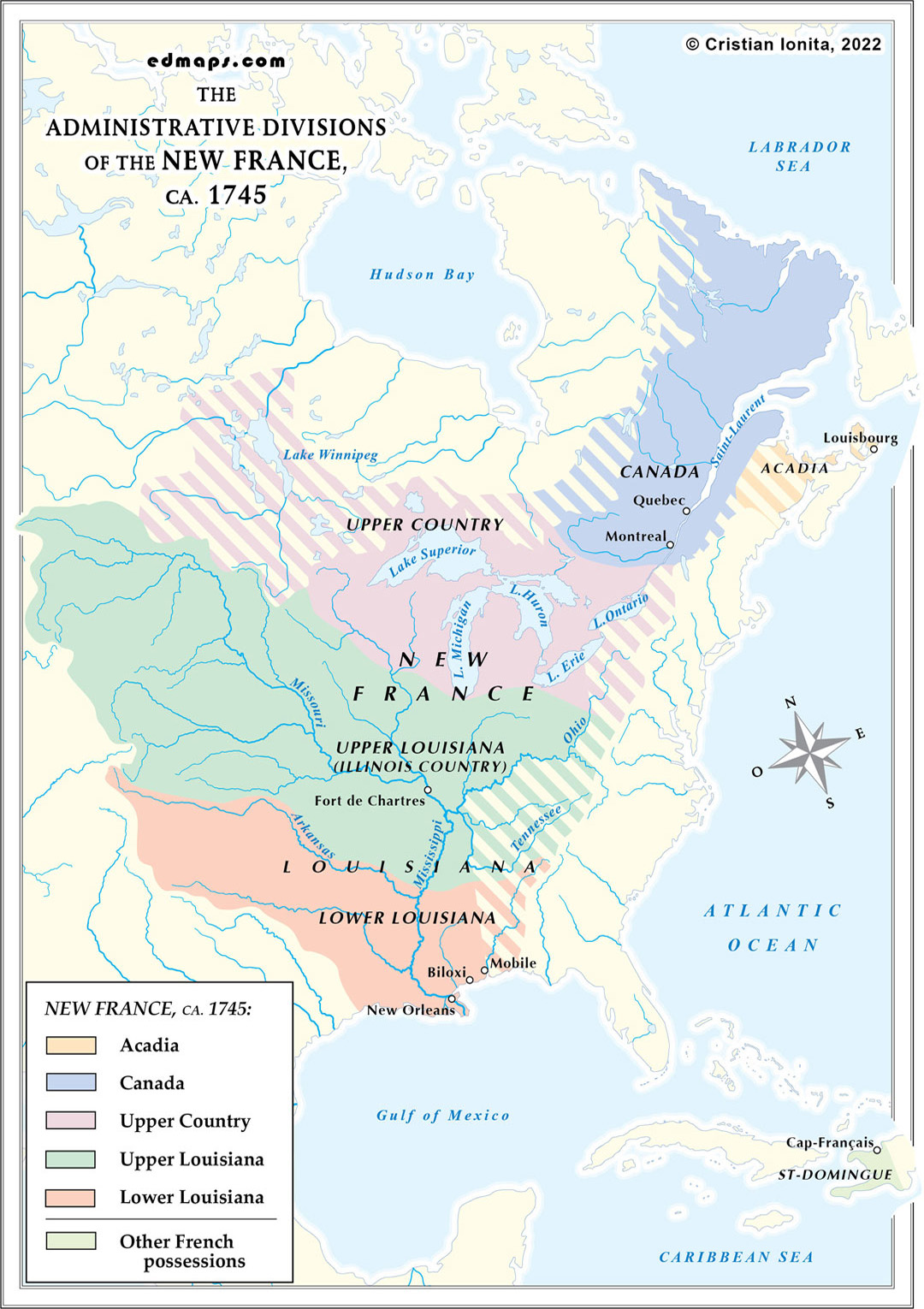
By 1745, New France had developed a sophisticated administrative structure to govern its vast continental empire, organized into several distinct territorial divisions that reflected geographic, economic, and strategic realities.
Canada proper formed the demographic and administrative heartland, encompassing the St. Lawrence River valley from Quebec City to Montreal. With approximately 45,000 inhabitants, this region featured established seigneuries, urban centers, and the primary governmental apparatus. The Governor-General and Intendant administered the colony from Quebec City, while Montreal served as the western commercial hub and military staging area.
The Upper Country extended across the Great Lakes region and surrounding territories, from the Ottawa River to Lake Superior's western shores. This immense area was governed through military commandants stationed at strategic posts like Michilimackinac, Detroit, and Fort La Baye (Green Bay). French control here relied primarily on fur trade networks and Native American alliances rather than permanent settlement.
The Louisiana territories were divided into two administrative zones. Upper Louisiana encompassed the Mississippi Valley from its source to approximately the Arkansas River's mouth, including the Illinois settlements around Kaskaskia, Cahokia, and Fort de Chartres. Lower Louisiana extended southward to the Gulf of Mexico, administered from New Orleans, which had served as the territorial capital and primary port since 1718. This subtropical region featured diverse populations, including French, Spanish, African, and Native American inhabitants, and controlled crucial Mississippi River navigation.
The Acadian territories presented a complex situation by 1745. Following the Treaty of Utrecht in 1713, France had lost peninsular Acadia (Nova Scotia) but retained nominal claims to continental Acadia, though British authority increasingly challenged this status. France's remaining Atlantic possessions centered on Île Royale (Cape Breton Island) and Île Saint-Jean (Prince Edward Island), with the heavily fortified Louisbourg serving as capital of the colony of Île Royale and France's crucial naval base protecting St. Lawrence approaches.
However, 1745 marked a catastrophic disruption of this administrative structure when British colonial forces captured Louisbourg in June, effectively disintegrating the Île Royale colony. French residents faced deportation or submission to British authority, and France's Atlantic maritime stronghold was lost. This remained the situation until the Treaty of Aix-la-Chapelle in 1748, which restored Louisbourg to French control in exchange for territorial concessions elsewhere, allowing the colony to begin its recovery and reassert its strategic role in New France's administrative framework.